
CLIMB: Physiology-Adaptive Motion-Bound Shared Control for UAV Inspection
Accepted at ISRR 2026, to appear. Joint work by Juan Jose Garcia and Sasanka Kuruppu Arachchige (equal contribution), with Joni-Kristian Kämäräinen and Adriana Tapus, between Tampere University and ENSTA, Institut Polytechnique de Paris, within the RAICAM doctoral network.
The problem
Inspecting bridges, power lines or nuclear facilities with a drone still needs a human in the loop, because the operator carries the judgement and the accountability. But flying through clutter from a camera view is exhausting, and an overloaded operator produces unstable commands. Full autonomy removes that burden, yet it is hard to trust with incomplete maps and unexpected obstacles.
Shared control sits between the two, and the open question is how much help to give. Fixed assistance can be too weak when the operator is overloaded and too restrictive when they are confident and flying well. CLIMB (Cognitive Load-Infused Model for Motion Bounds) does not switch between manual and autonomous modes. It continuously adjusts how much freedom the operator has, based on how they are doing.
Completion time
−23.6%
vs direct teleoperation (−50.7% vs fixed bounds)
NASA-TLX workload
−26.95
vs direct teleoperation (−12.38 vs fixed bounds)
User study
N = 21
63 trials across three conditions
How it works
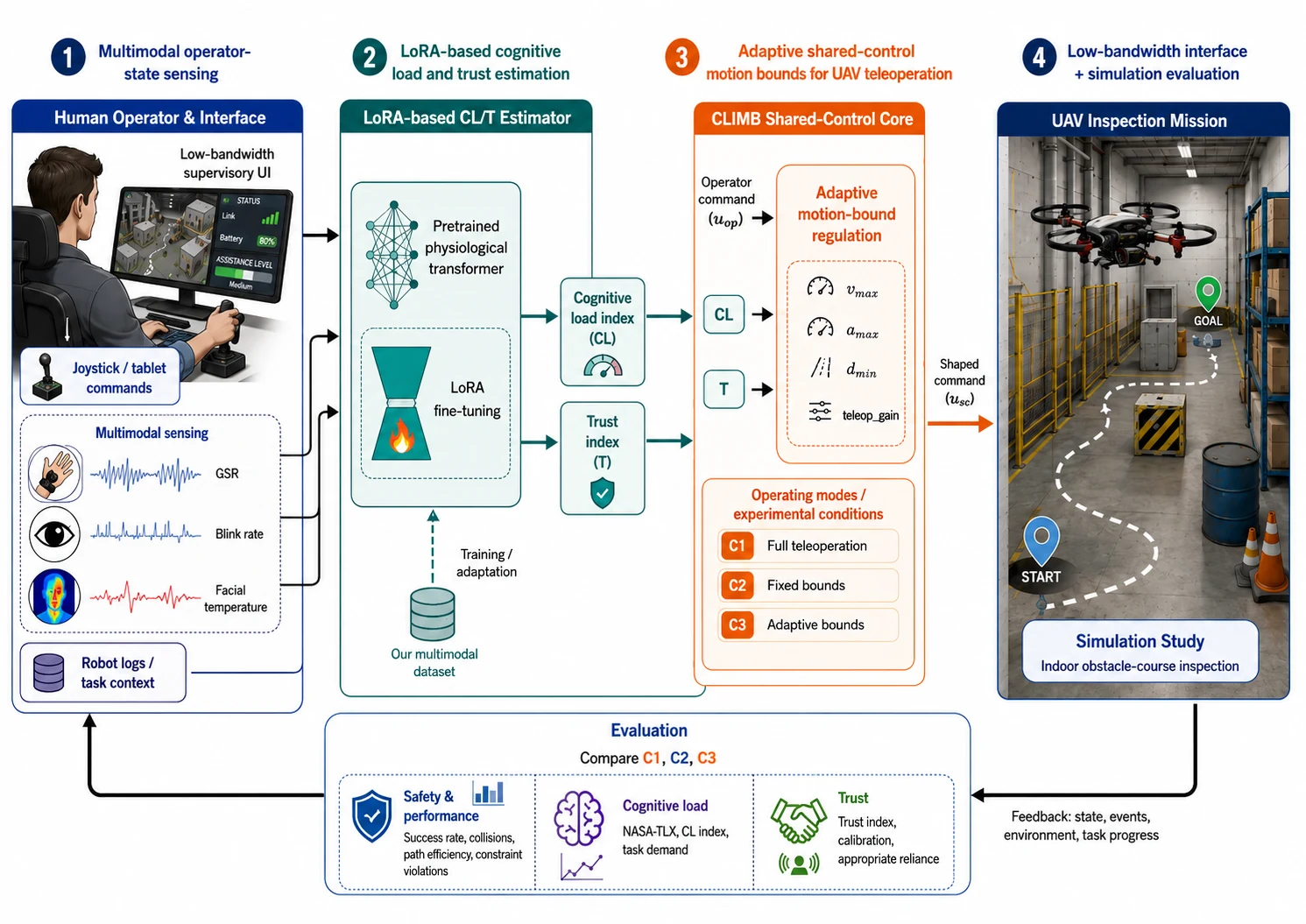
- Reading the operator. Skin conductance, blink rate, facial temperature from a thermal camera, operator commands and task context are synchronised into 10-second windows with 50% overlap. A compact temporal transformer turns each window into two normalised indices: cognitive load and trust.
- Little data, small adaptation. Physiological datasets are small and vary between people, so full fine-tuning is a poor fit. We freeze a backbone pretrained with masked reconstruction and train only low-rank LoRA adapters (rank 8) and two output heads on a participant-disjoint split of the Physio-HRC dataset. On held-out validation participants the estimator reaches an MAE of 0.115 for cognitive load and 0.148 for trust, a 15.8% lower error than a baseline that uses only command and task features. It stays fixed during the trials.
- Adapting the motion bounds. The smoothed indices scale a bound vector made of maximum velocity, maximum acceleration, minimum obstacle distance and teleoperation gain. High trust or low load relaxes the bounds; low trust or high load tightens them. At the neutral state, the adaptive controller matches the fixed-bound baseline exactly.
- Safety is shared. Each operator command is projected onto the closest command that satisfies the active bounds and a first-order obstacle-distance constraint. The obstacle-aware filter is identical in the fixed and adaptive conditions, so differences between them come only from how the bounds are scheduled.
The simulation
The study runs in AgiPIX, our photorealistic Isaac Sim digital twin connected to a ROS 2 autonomy stack, on a fixed indoor obstacle course inspired by nuclear inspection, with narrow corridors, partial occlusions and clutter near the goal. Because the same stack also runs on the real drone, the framework can move to hardware by changing only the execution platform.
Twenty-one participants, disjoint from the estimator's training data, flew the course once in each of three counterbalanced conditions: direct teleoperation (C1), shared autonomy with fixed motion bounds (C2), and shared autonomy with adaptive bounds (C3).
Results
| Metric | C1 Direct | C2 Fixed bounds | C3 Adaptive |
|---|---|---|---|
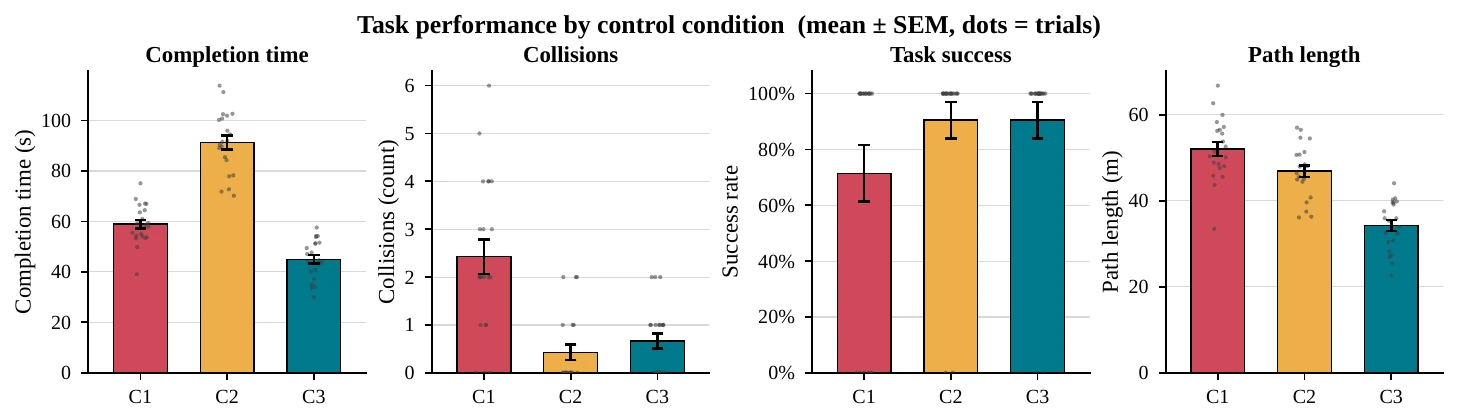
| Completion time (s) | 58.90 ± 7.90 | 91.29 ± 12.42 | 44.99 ± 7.87 |
| Collisions (count) | 2.43 ± 1.66 | 0.43 ± 0.75 | 0.67 ± 0.73 |
| Task success | 71% | 90% | 90% |
| Path length (m) | 52.06 ± 7.32 | 46.89 ± 6.28 | 34.22 ± 5.85 |
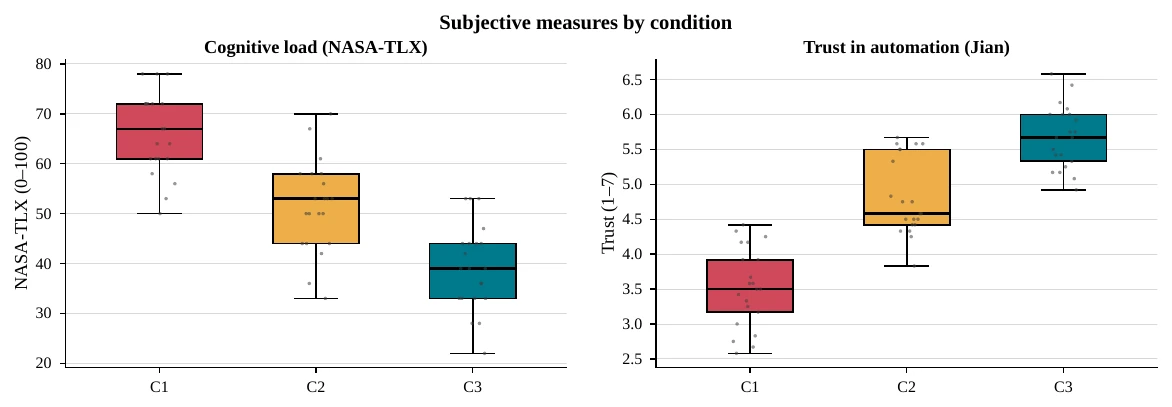
| NASA-TLX workload (0–100) | 66.14 ± 8.21 | 51.57 ± 9.16 | 39.19 ± 8.52 |
| Trust (Jian scale, 1–7) | 3.52 ± 0.56 | 4.82 ± 0.56 | 5.68 ± 0.45 |
Adaptive bounds kept the safety benefit of shared autonomy without its cost in speed. Fixed bounds reduced collisions but were too conservative, taking twice as long as adaptive control. Adaptive control was the fastest and shortest-path condition, and participants found it the least demanding and the most trustworthy.
The body agrees with the questionnaires
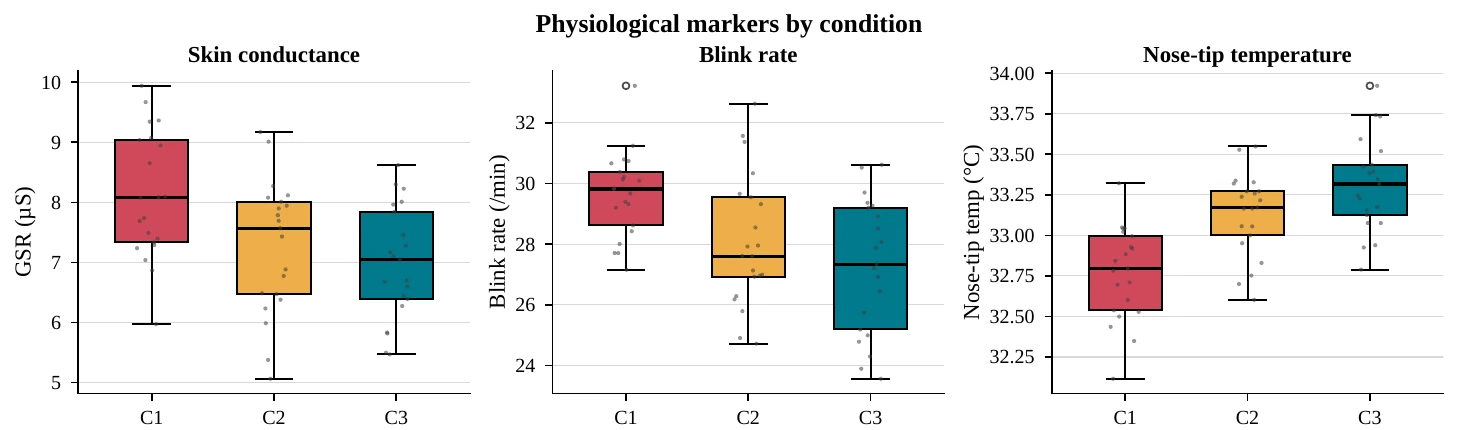
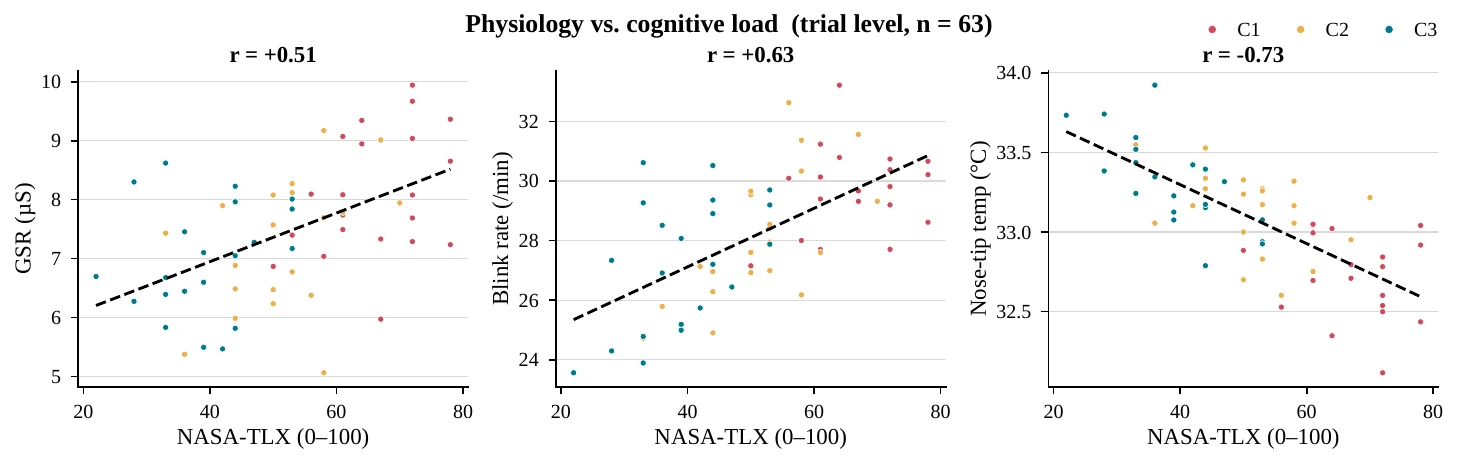
Physiological markers moved in the same direction as the ratings. Direct teleoperation produced the highest skin conductance and blink rate and the lowest nose-tip temperature, and NASA-TLX correlated with all three across trials (r = 0.51 for skin conductance, r = 0.63 for blink rate, r = −0.73 for nose-tip temperature).
What the results do not show
- The safety gain comes from shared bounded control and its obstacle filter. Collisions did not differ significantly between fixed and adaptive bounds (p = 0.24), and task success was not significantly different across conditions (p = 0.14).
- Skin conductance and blink rate did not differ significantly between the fixed and adaptive conditions, so physiology gives convergent but not definitive evidence of lower workload there.
- Trust was highest with adaptive bounds, but we do not claim better trust calibration, because late interventions and unnecessary restrictions were not measured directly.
- This is a simulation study on one fixed indoor course, with no injected latency or packet loss.
What's next
The next steps are deploying CLIMB on a real drone, evaluating sim-to-real transfer, testing online LoRA personalisation for each operator, and extending adaptive motion bounds from a single UAV to multi-robot field operations.
Publication
Juan Jose Garcia*, Sasanka Kuruppu Arachchige*, Joni-Kristian Kämäräinen and Adriana Tapus, CLIMB: Physiology-Adaptive Motion-Bound Shared Control for UAV Inspection, accepted at ISRR 2026, to appear. (*Equal contribution.) The DOI and BibTeX will be added here once the paper is published.
This work was supported by the European Commission's Marie Skłodowska-Curie Actions (MSCA) project RAICAM (GA 101072634). The study was conducted in accordance with institutional research-ethics guidelines at ENSTA, IP Paris, with informed consent from all participants.