Accepted at ISRR 2026 · To appear
CLIMB: drone motion limits that adapt to the operator
Inspecting a cluttered industrial site by drone usually still needs a person in the loop, and flying through narrow gaps from a camera feed is demanding. Direct control can overload the operator. Fixed assistance has the opposite problem: it can be too weak when the operator is overloaded and too restrictive when they are doing well.
CLIMB (Cognitive Load-Infused Model for Motion-Bounds) adjusts the assistance during flight. It estimates how loaded the operator is and how much they trust the system, then tightens or relaxes the drone’s motion limits to match. The operator keeps control throughout, with no switch between manual and autonomous modes.

How it works
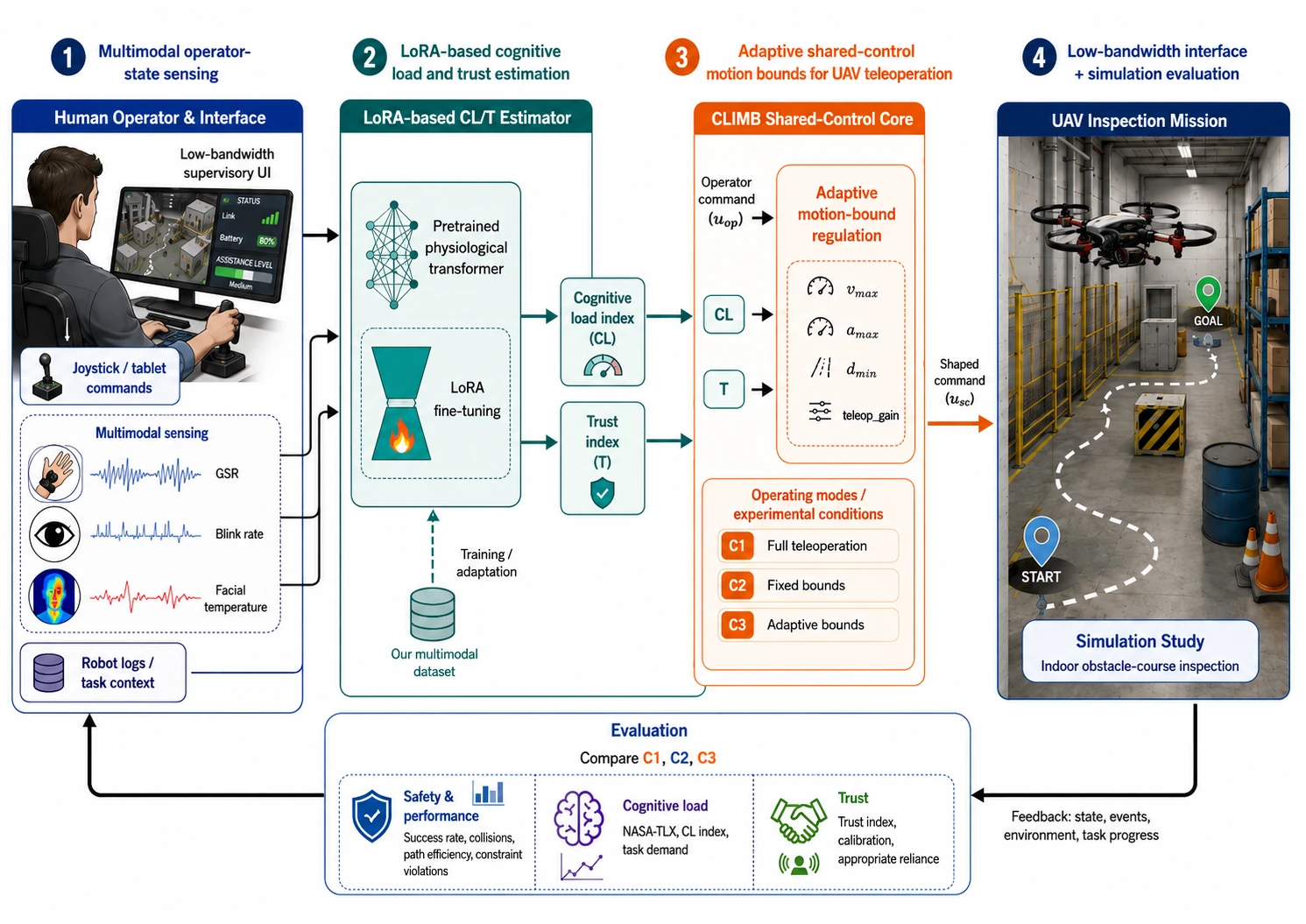
CLIMB runs three steps in a loop:
- Sense. Skin conductance, blink rate and facial temperature are synchronised with the operator’s commands and the task state, in 10-second windows that overlap by half.
- Estimate. A compact temporal transformer turns each window into a cognitive-load score and a trust score, both between 0 and 1. It is adapted with Low-Rank Adaptation (LoRA), trained offline on other people’s data, and kept fixed during flights.
- Bound. The scores set four limits: maximum velocity, maximum acceleration, minimum obstacle clearance and teleoperation gain. Higher trust or lower load relaxes the limits; lower trust or higher load tightens them. The drone then flies the permitted command closest to what the operator asked for.
At neutral scores the limits are 1.5 m/s, 2.0 m/s², 0.3 m clearance and a gain of 0.9. During flight they can move within 0.8–2.5 m/s, 1.0–3.0 m/s², 0.2–1.2 m and 0.5–1.5.
The study
Twenty-one people flew a fixed indoor obstacle course, inspired by nuclear inspection sites, in the AgiPIX Isaac Sim digital twin. None of them were in the data used to train the estimator. Each person flew three conditions in counterbalanced order: direct teleoperation, shared control with fixed limits, and shared control with CLIMB’s adaptive limits.
Means across the 21 participants:
| Measure | Direct | Fixed limits | Adaptive (CLIMB) |
|---|---|---|---|
| Completion time (s) | 58.90 | 91.29 | 44.99 |
| Path length (m) | 52.06 | 46.89 | 34.22 |
| Collisions per run | 2.43 | 0.43 | 0.67 |
| Task success | 71% | 90% | 90% |
| Workload, NASA-TLX (0–100, lower is better) | 66.14 | 51.57 | 39.19 |
| Trust, Jian scale (1–7, higher is better) | 3.52 | 4.82 | 5.68 |
- Speed. Adaptive limits were 23.6% faster than direct control and 50.7% faster than fixed limits, which proved too cautious. Paths were also shortest.
- Workload and trust. Adaptive limits gave the lowest workload, 26.95 points below direct control and 12.38 below fixed limits, and the highest trust.
- Safety. Both forms of shared control had significantly fewer collisions than direct control. The difference between fixed and adaptive limits was not significant, so adapting the limits bought speed and comfort without a measurable safety change.
- Task success. The rates point the same way, but the overall difference was not statistically significant.
- Physiology. Skin conductance and blink rate were lower with shared control than with direct control, though adaptive and fixed limits did not differ significantly on either. Nose-tip temperature, which fell as reported workload rose, was highest with adaptive limits.
What this does not show yet
- All results come from simulation, on one fixed course, with 21 people. CLIMB has not yet been tested on a real drone.
- The study did not inject latency or packet loss, so the low-bandwidth interface has not been stress-tested.
- Full standalone validation of the estimator is still to come.
- Trust ratings were higher with adaptive limits, but the study does not claim better trust calibration, because late interventions and unnecessary restrictions were not measured directly.
Next steps are deploying CLIMB on a real drone, measuring sim-to-real transfer, testing online personalisation of the estimator, and extending the approach to multi-robot operations.
The paper
CLIMB: Physiology-Adaptive Motion-Bound Shared Control for UAV Inspection. Juan Jose Garcia, Sasanka Kuruppu Arachchige, Joni Kämäräinen and Adriana Tapus. Accepted at ISRR 2026, to appear. The paper is not published yet; a link and citation will be added here when it is.
This work was supported by the European Commission’s Marie Skłodowska-Curie Actions project RAICAM (GA 101072634).