
The study in one minute
- The question. Dynamic-scene visual-inertial odometry often masks every object of a movable class. We asked when that helps, with controls: each simulated warehouse trajectory is rendered at four traffic levels, from static to heavy, and the test split was frozen before it was rendered.
- Masking helps when moving objects carry a large share of the measurements. In medium and heavy traffic, SAVIOR cut the error of OpenVINS by 48 % and was better on all 24 test trajectories. The gain comes from heavy traffic, where a forklift drives ahead of the camera; with few movers, no gain was detected.
- Masking every movable class has a cost. It raised the error in static scenes by 42 %, because parked boxes and pallets are good landmarks. SAVIOR keeps them by default and beat all-class masking by 27 to 34 %.
- A simple class prior does most of the work. Masking only people and forklifts did not differ detectably from SAVIOR's per-instance reasoning. A stress test with large moving loads was inconclusive.
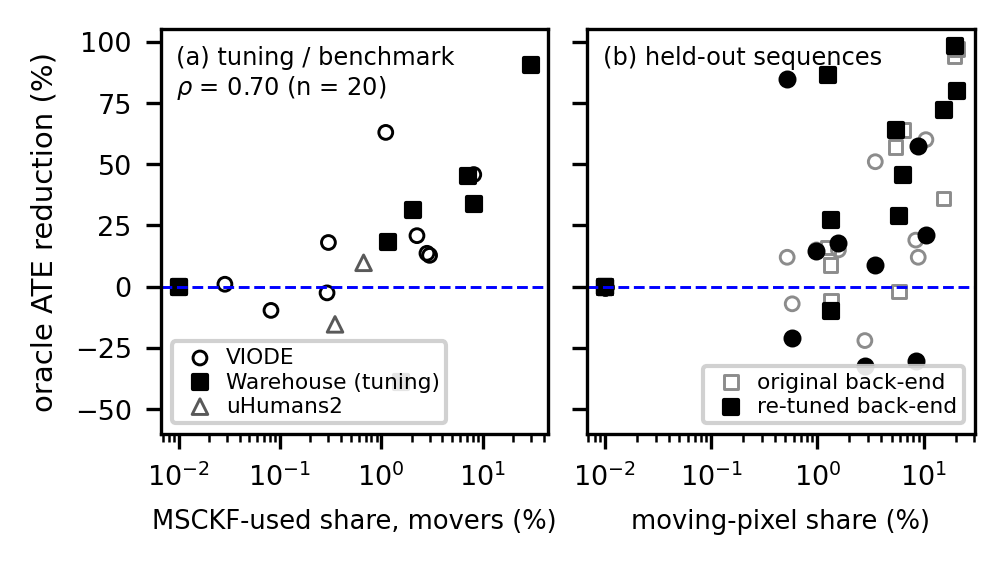
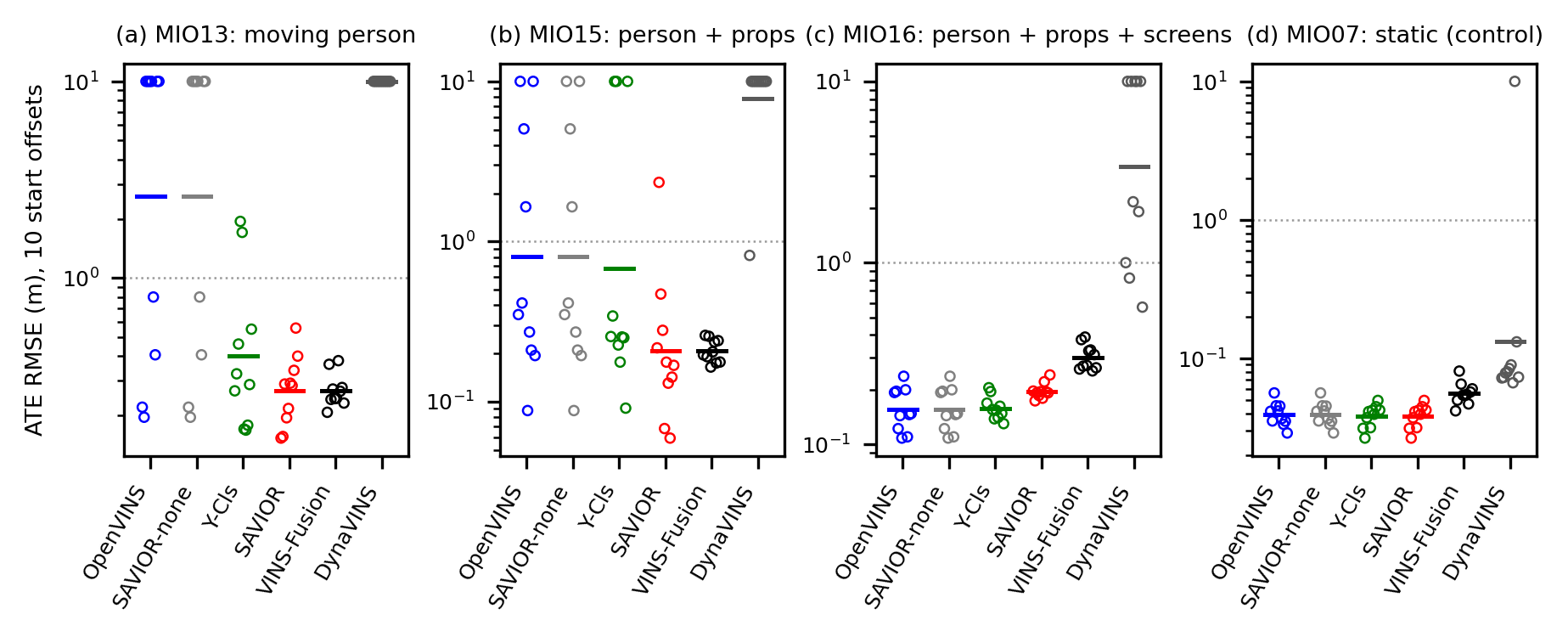
- A tuned filter is a strong rival in simulation, but not on real data. A tighter outlier gate in the filter beat the masks in simulation. On real walking-person sequences, tuned gates failed in 14 to 19 of 30 runs, against 1 of 30 with masks.
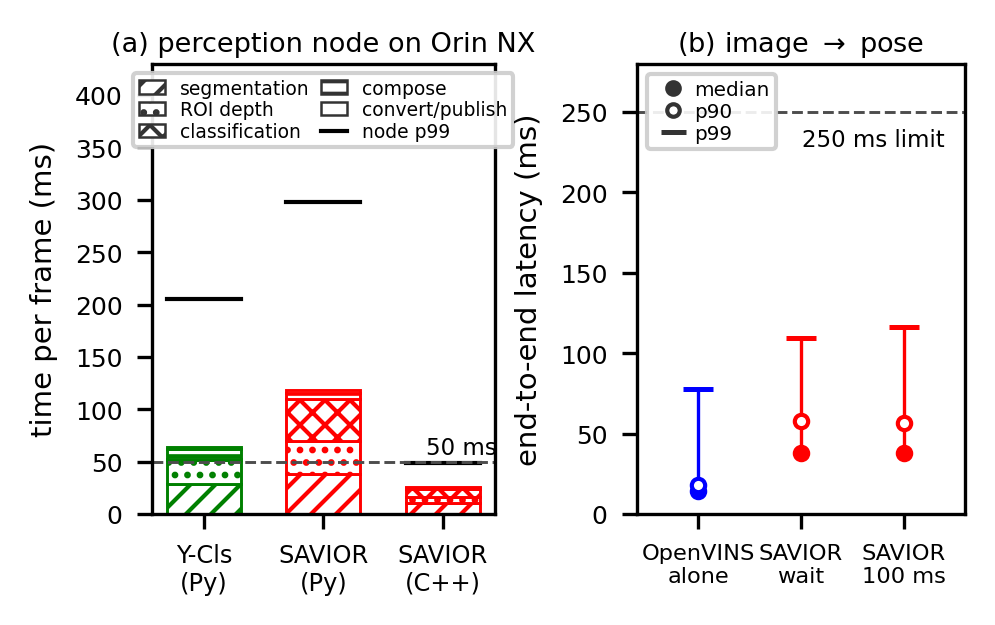
- Practical. One mask image per frame is the only interface, so the same front end serves three unmodified estimators. The C++ node runs at the 20 Hz camera rate on a Jetson Orin NX.
Latest (November 2026). The paper is now framed as a controlled study of when masking helps. New since the first version: a class-prior baseline, a pre-specified stress test with dominant loads, a comparison with tuned and real-data-calibrated filter gates, and a check of how much the results depend on the environment.
Method
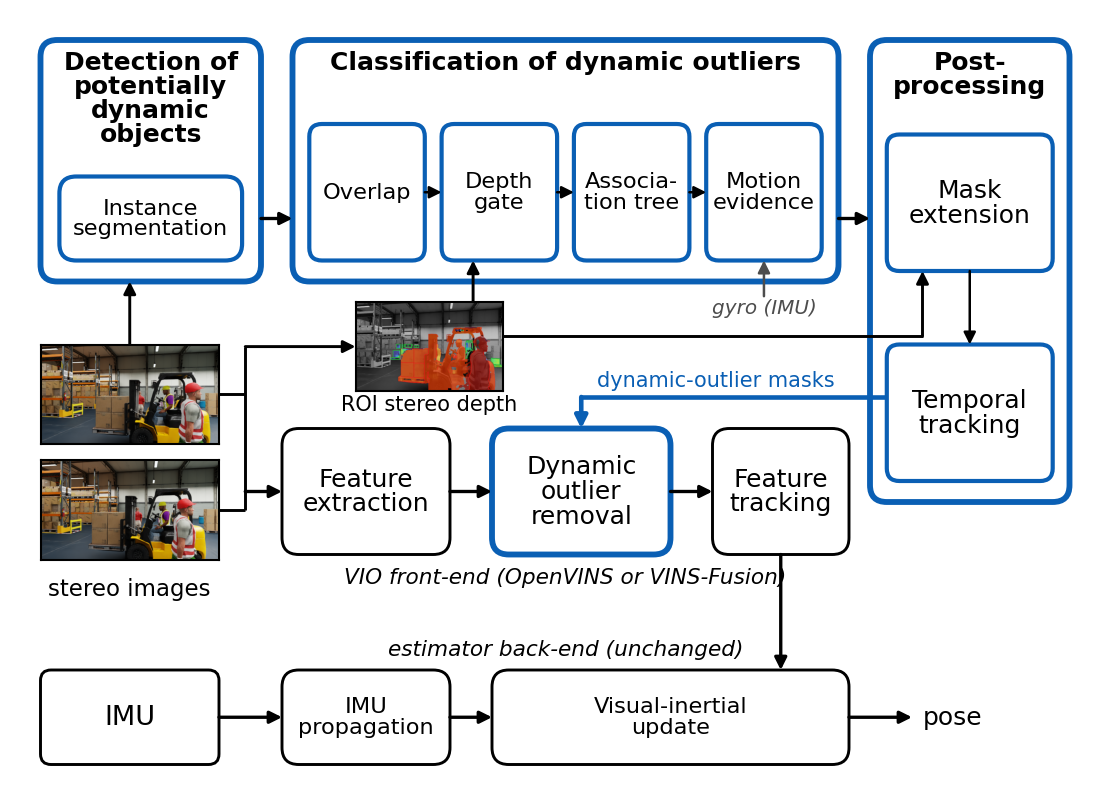
SAVIOR removes the features of moving objects in the VIO front end. The estimator itself is not modified: it only sees fewer features. Stereo images and the IMU are the only inputs.
Class prior
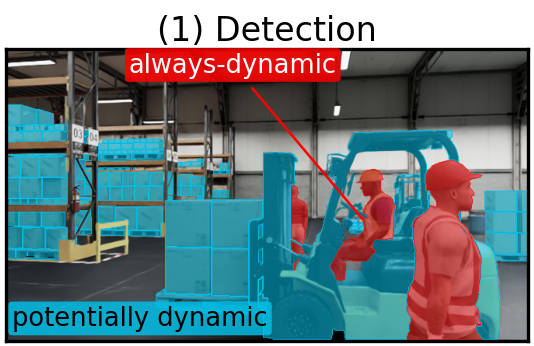
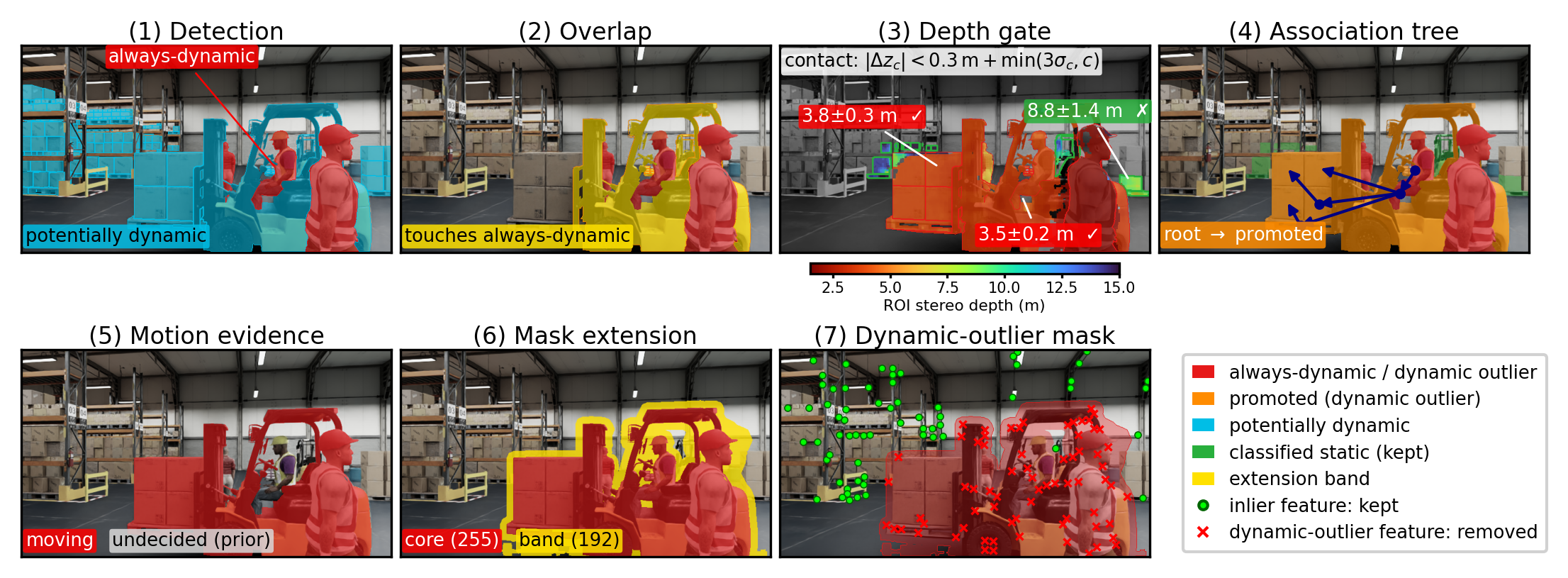
People are always masked. Forklifts, boxes, pallets and trolleys are only masked when there is evidence they move. Racks and walls are never masked.Depth and association
Stereo depth links objects that touch in space, not just in the image. A link spreads from a mover to what it carries: person, then forklift, then load.Motion evidence
IMU-compensated image motion confirms which objects move. An object stays masked until it has been confirmed static.Mask interface
One 8-bit mask per camera and frame. An empty mask leaves OpenVINS bit-identical, which gives an exact control.One frame, step by step
A driven forklift carries a pallet with four boxes, and a person walks in front. The steps run SAVIOR's code on ground-truth instance masks, so they show the decision logic, not segmentation errors.
SAVIOR-Warehouse dataset
No public stereo-inertial dataset lets you change the traffic while keeping everything else fixed. SAVIOR-Warehouse, rendered in NVIDIA Isaac Sim, renders every trajectory four times, from a static scene to heavy traffic with people, forklifts and carried loads. Camera path, scene and IMU noise are identical, so any difference comes from the moving objects.
The test split, 24 new trajectories in four environments (one from a different asset family), was frozen before rendering, together with the methods, five hypotheses and the analysis. The sensor is a ZED 2i-like stereo pair (672×376, 20 Hz) with a 200 Hz IMU, with ground-truth poses, depth and instance masks.
Results
Error is the absolute trajectory error, compared in pairs per trajectory; negative is better.
The pre-registered test
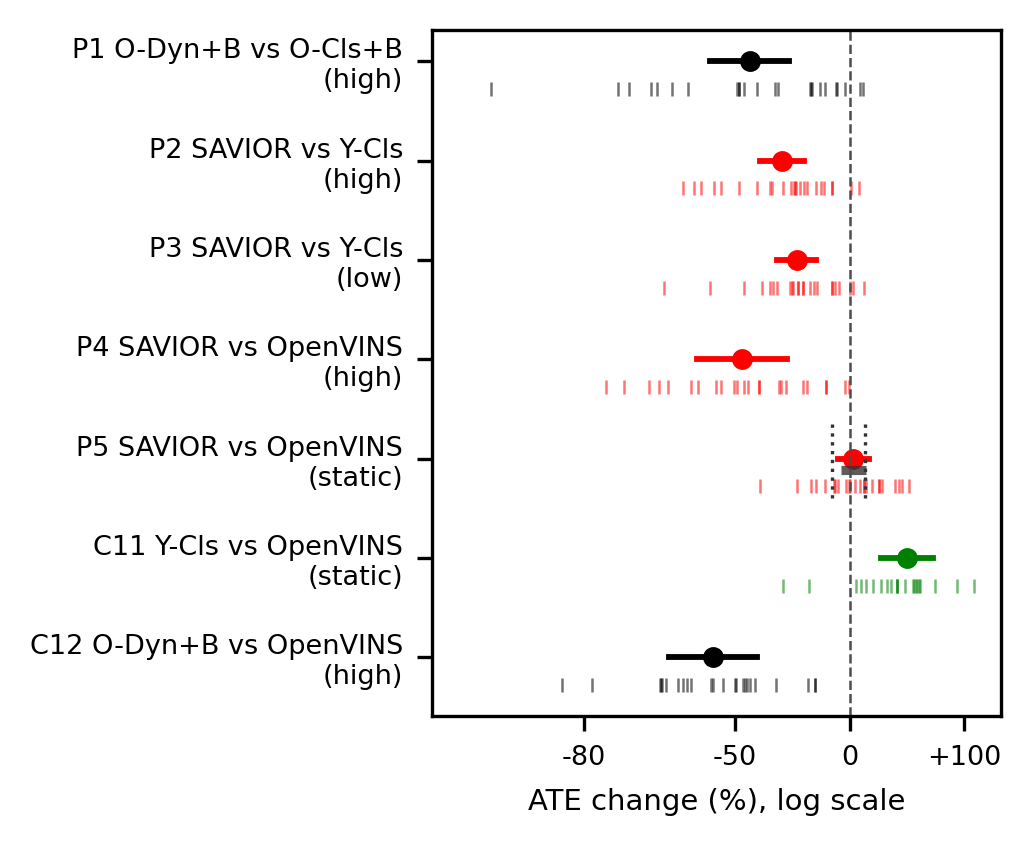
- perfect masks of moving objects beat perfect masks of all movable classes (−45 %);
- SAVIOR beat all-class masking (Y-Cls) in medium and heavy traffic (−34 %) and in static and light traffic (−27 %);
- SAVIOR beat the unmasked filter in medium and heavy traffic (−48 %).
Real sequences
Real time on a Jetson Orin NX
The C++ node runs at the 20 Hz camera rate on a Jetson Orin NX 8 GB: 24.5 ms median and 49.1 ms p99 per frame, 110 ms end-to-end p99 latency from image to pose, at 10.9 W. It reproduces the Python reference bit for bit. In closed loop on the device, accuracy was 0.92 to 1.32 times the desktop value, with no failures.
Limitations
- The main evidence is simulated, and the segmenter was trained in the same simulator. The real sequences contain only walking people (three sequences), no forklifts or loads.
- SAVIOR's per-instance reasoning was not shown to improve on the class prior.
- All gains are relative to the filter's default outlier gate. In simulation, a tuned gate beat the masks.
- On the warehouse, unmasked DynaVINS is the most accurate system tested. Masks matter most for the filter that would otherwise fail.
- The effect on accuracy of the deployment timeout, which drops 0.4 to 7 % of the masks, was not evaluated.
Code and data
Code, frozen configurations and the evaluation artefact are in the repository; start with the README, docs/DATA.md and experiments/README.md. The dataset and raw outputs are on Zenodo: record A (dataset and artefact), and records B and C (test split). Runs are deterministic offline replays with five start offsets per sequence, and an empty-mask control reproduced OpenVINS bit for bit in all 480 test runs. The freezes are internal checksums, not registered with a third party.
Cite
The paper is under review; please cite the software and artefact for now.
@software{savior_code,
  title        = {{SAVIOR}: code, frozen configurations and evaluation artefact},
  author       = {Kuruppu Arachchige, Sasanka and Lee, Kyuman},
  version      = {1.0.0},
  year         = {2026},
  month        = oct,
  doi          = {10.5281/zenodo.23803392},
  url          = {https://github.com/SasaKuruppuarachchi/SAVIOR},
  license      = {GPL-3.0-or-later},
  note         = {Paper under review}
}